Starting out
Junk Hauling Business: Dump Trailer or Box Truck?
Dump trailer, box truck, stake bed or pickup: what each setup costs, how much it hauls, how fast it unloads at the dump, and which one fits a new junk hauling business.
 JunkPilot7 min read
In this article
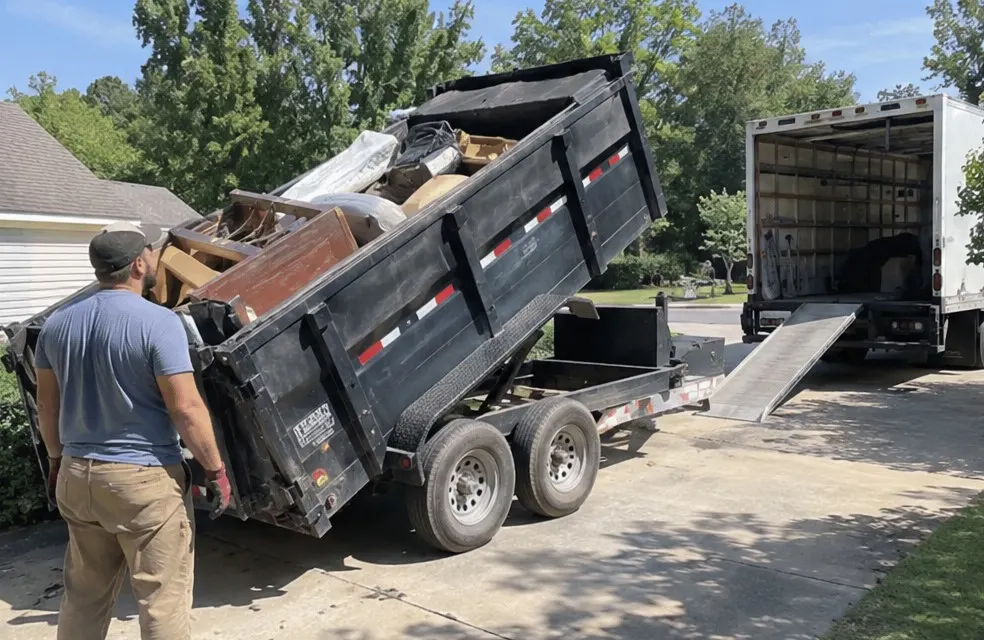
Choose the vehicle by three numbers: how many cubic yards it holds, how many pounds it may carry, and what it costs you per job. For a first junk hauling business the usual choice is a pickup that can tow, plus a dump trailer, because the trailer holds a real load and tips at the dump. The deciding number is weight: in the example below, a 14 foot trailer piled with mixed junk weighs roughly 3,600 to 4,300 pounds, but the same space piled with dirt is almost 3,000 pounds over its limit. So read the ratings on your own vehicle before you read any list.
The numbers here are from one trailer maker's page, one pickup maker's page and two federal regulations, as we read them on 15 November 2026, plus round example numbers. Federal motor carrier rules and state rules differ by what you haul and where, so this guide shows where to check. It is for the United States and is not legal advice.
What does a trailer hold, in space and weight?
The PJ Trailers D7 14K dump trailer lists an 83 inch bed width, a 14 foot bed length and 24 inch sides, with a 14,000 lb GVWR, a 10,340 lb load capacity and 3,660 lb empty. (GVWR is the most the trailer may weigh loaded.) The page lists no price, and says that all pricing is set by the dealers.
- Space level with the sides: 168 x 83 x 24 inches is 334,656 cubic inches, which is 7.2 cubic yards
- Space piled to 48 inches (an example height: carry only what you can tie down): 14.3 cubic yards
- Weight limit: 10,340 lb
Now the weight of what fills it. The U.S. Environmental Protection Agency (EPA) lists mixed municipal solid waste, uncompacted, at 250 to 300 pounds per cubic yard, and dirt and sand at 929:
| Load in the trailer | Cubic yards | Pounds | Against the 10,340 lb limit |
|---|---|---|---|
| Mixed household junk, piled to 48 in | 14.3 | 3,575 to 4,290 | Under, with room |
| Dirt, level with the sides | 7.2 | 6,689 | Under |
| Dirt, piled to 48 in | 14.3 | 13,285 | Over by 2,945 |
Dirt reaches the limit at 10,340 / 929, about 11.1 cubic yards, so a trailer about 78 percent full of dirt (by the piled volume above) is already at its limit. Household junk fills the space first. Heavy debris fills the weight first. That is why heavy material is priced by the yard: see dump fees.
Can your pickup pull it?
Not just because the trailer's rating is high. A trailer rated 14,000 lb at the top has a loaded weight of 3,660 empty plus the load. The Ford F-150 capability page lists "Max Available Gas Towing 13,500 lbs" and "Max Available Gas Payload 2,430 lbs" as the top figures for the line, for the best configuration. Your truck is probably lower, and that 14,000 lb trailer fully loaded is above even the top figure. Read three labels:
- Your truck's door label: its payload, which must cover the load in the bed and the trailer's tongue weight
- Your owner's manual: the towing capacity for your engine, axle and hitch
- The trailer's plate: its GVWR and empty weight
Then weigh a loaded trailer at a public scale once and write the number on the dash. Most junk jobs are light, but the one that is not is the one that costs you.
What do the four setups look like?
| Setup | What we could read | What to check |
|---|---|---|
| Pickup alone | The F-150 top figure above is 2,430 lb of payload. An example 78 x 60 x 20 inch bed is 2 cubic yards | Your door label. Every dump run pays the dump's minimum |
| Pickup plus dump trailer | 7.2 cubic yards level, 14.3 piled to 48 inches, 10,340 lb capacity. It tips, and you can leave it at a big job | The tow rating, a place to park it, and whether your HOA or city allows it |
| Box truck | We could not read a box-truck maker's page today, so we print no figures | Its payload and GVWR from the maker's sheet, deck height, a ramp or liftgate, and how long you take to unload by hand: time it |
| Dump body truck | Same: no maker's page read | Its payload, which is the limit before the dump body is full of heavy debris |
Use the unload time as a number: time yourself unloading three real jobs and put it in the table. A dump visit costs the crew's hours, and the example crew hour is $60.
What does the vehicle cost in each job?
The cost of a vehicle is its payment divided by the jobs you do. At 9 percent over 60 months (assumptions), a $40,000 vehicle costs $830 a month and a $60,000 one costs $1,246: see the startup budget. Our other guides use $1,200 a month for the truck and the trailer. Spread it:
| Jobs a month | Vehicle cost per job at $1,200 |
|---|---|
| 23 (break-even in the example) | $52.17 |
| 38 | $31.58 |
| 60 | $20.00 |
Each job in the example leaves $132 after the crew and the dump, so a $52 vehicle cost is large at 23 jobs and small at 60. A cheaper vehicle lowers the break-even. A bigger one only pays if it lets you do more jobs or bigger ones.
Do you need a USDOT number or a CDL?
It depends on the vehicle's weight and where you drive, and we could not open the Federal Motor Carrier Safety Administration's "Do I need a USDOT number" page today, so read it yourself and ask your state transportation agency. Two federal definitions you can read now:
- Commercial motor vehicle: the federal definition at 49 CFR 390.5T says it is a vehicle that has a gross vehicle weight rating or gross combination weight rating, or gross vehicle weight or gross combination weight, of 4,536 kg (10,001 pounds) or more, whichever is greater. The trailer above is rated 14,000 lb on its own
- Interstate commerce: it includes trade, traffic, or transportation in the United States between a place in a State and a place outside of such State
So a junk company that never leaves its state may fall under state rules and not federal ones, and one that crosses a state line may fall under the federal ones. Also, a commercial driver's license is a different test: 49 CFR 383.91 puts a single vehicle in Group B when it has a GVWR of 11,794 kilograms or more (26,001 pounds or more). Read the GVWR on the door label of any truck you consider. Ask your state agency and your insurer, because insurance and registration rules come with the vehicle.
How do you secure the load?
An unsecured load is the fastest way to lose a day, and the law is plain. The federal rule says a driver may not operate a commercial motor vehicle unless its cargo is properly distributed and adequately secured (49 CFR 392.9). States have their own rules: Florida's statute says that a vehicle may not be driven or moved on any highway unless the vehicle is so constructed or loaded that its load does not drop, shift, leak, blow or otherwise escape, and calls a violation a noncriminal traffic infraction. Dumps add their own rule. Weber County, Utah's page says that all uncovered commercial loads will be charged double, and the Napa area page lists a $19 uncovered load fee per vehicle. We do not teach tie-down methods here: read the federal and state rules above, and ask your insurer.
How do you choose?
- What do you already own? If your pickup tows the loaded trailer by its own label, a trailer is the lowest cost way in
- What will you haul most? Furniture and household junk fill space first. Debris and yard waste fill weight first
- How far is the dump? Check the dump's hours too: Weber County lists closing at 5 p.m. on weekdays and being closed Sunday, and the Napa area page lists 8 a.m. to 4 p.m. every day
- Where will you park it? Some cities and HOAs restrict commercial trucks and trailers: ask yours in writing
What makes it look professional?
Put your name, phone number and website on both sides and the back. Keep it clean. Tarp and tie every load. Then fill it: the next job comes from a website that shows load prices, a Google profile and a phone that gets answered. See how to get junk removal customers.
Frequently asked questions
What is the best truck for a junk removal business?
There is no single best one, so choose by three numbers: cubic yards it holds, pounds it may carry and what it costs you per job. For many new owners a pickup that can tow plus a dump trailer is the lowest cost start, because it holds a real load and tips at the dump. Read your own truck's door label and the trailer's plate before you buy.
How big should a junk removal trailer be?
Measure what you need in cubic yards: length times width times height in inches, divided by 46,656. One maker's 14 foot dump trailer with 24 inch sides holds about 7.2 cubic yards level with the sides, and its page lists a 10,340 lb load capacity. Household junk fills the space first, and dirt or concrete fills the weight limit first.