Services
Garage Clean Out Business: How to Quote, Sort and Profit
How to run garage clean outs as a business: what to charge, how to quote multi-load jobs, how to sort for donation and scrap, and how to fill your schedule.
 JunkPilot6 min read
In this article
Price a garage clean out by the loads it fills plus the time you spend sorting with the customer, then add a line for each thing the dump charges for separately. In the round example below, a one-car garage that fills 1.7 truck loads is quoted at $925 for the haul and $75 for an hour of sorting. It leaves about $404 after the crew, the dump and overhead. The sorting hour is where garage jobs differ from a curbside pickup, so it gets its own line.
All numbers here are examples that match our pricing guide: a crew hour of $60, a load ladder of $175 for the first quarter and $125 for each quarter after, and $50 of overhead for each job. Change each one to yours. This guide is for the United States. Nothing here is legal advice.
Why do garage clean outs suit a junk company?
The customer is usually home, the job is a known size and a garage fills more than one truck load. A garage also holds things with a second life: tools, bikes, metal shelving and old appliances can go to donation or scrap and not to the landfill. And the before and after photo of an empty garage is the picture customers share.
Not all of it is good news. Garages are where paint, oil, pool chemicals and batteries end up, and the dump may refuse them. Plan for that at the quote, not at the dump.
What do customers want?
Ask which of three jobs it is on the first call, because the price and the time change:
- Full clear out. Moving, selling a house or an estate. Everything goes
- Clear and keep. "Take the junk, leave the tools and the holiday boxes." This needs a walk through with the customer, so budget sorting time
- Clear and organize. The customer wants shelves and a floor to park on. Offer it only if you do it, or refer it
How do you size a garage?
Ask for photos from the door, from the back wall and of any loft or shelving. Then do the volume sum. Example: a one-car garage with a floor of 12 by 20 feet, with about half the floor covered 3 feet high. That is 120 square feet times 3 feet, which is 360 cubic feet. A cubic yard is 27 cubic feet, so that is 13.3 cubic yards. If your full load is 8 cubic yards (see pricing per load for how to measure yours), the job is 1.67 loads. Round up to the next quarter: seven quarters.
Quote a range of two sizes, such as "one and a half to two loads", and confirm on site, because the treadmill behind the shelving does not show on a photo.
What does the worked job cost and leave?
The ladder prices seven quarters at $175 plus six times $125, which is $925. The crew time is a full load at 3.5 hours plus three quarters at 2.75 hours, which is 6.25 hours. All the times are assumptions: time yourself.
| Line | Amount |
|---|---|
| Haul, seven quarters | $925 |
| Sorting with the customer, 1 hour (calculator example add-on) | $75 |
| Charged | $1,000 |
| Crew, 6.25 hours plus 1 sorting hour at $60 | $435 |
| Dump, one full load ($63.70) and one three-quarter load ($47.78) | $111.48 |
| Overhead | $50 |
| Left | $403.52 |
The dump numbers are the example weights from the pricing guide at $91 a ton. The U.S. Environmental Protection Agency (EPA) lists mixed residential waste at 250 to 300 pounds per cubic yard, and 13.3 cubic yards at 250 pounds is 3,325 pounds, so weigh your tickets: at Napa's $91 a ton that would be $151 and the "left" line falls to about $364. See dump fees for the three rate pages.
What extras does a garage add?
Price each one from your dump's page and your time, not from this table. These are the example add-ons in the JunkPilot calculator next to what the public dump pages list:
| Extra | Calculator example | What the dump pages list |
|---|---|---|
| Sorting with the customer, per hour | $75 | Not a dump fee: it is crew time |
| Sweep out | $60 | Not a dump fee |
| Old refrigerator or freezer | $45 | Napa area: $29 a unit; Weber County: $10 for Freon removal; DeKalb County: $50.40 each |
| Tires, each | $15 | Napa area $20 each at 16 inches or less; Weber County $4; DeKalb County $3.50 under 18 inches |
| Light demolition, such as a workbench | $250 | Not a dump fee: it is crew time |
The EPA says that the final disposer of appliances is responsible for recovering any refrigerant contained in appliances. A chest freezer is an appliance, so ask the dump what it wants before you load one, and say on the quote that the fee is extra.
What do you do with paint, chemicals and batteries?
The EPA tells people to contact your local environmental, health, or solid waste agency to learn about permanent or periodic HHW collections. The public pages we read differ: Weber County, Utah lists a $20 a load household hazardous waste drop-off on Thursdays and Saturdays, and the Napa area page lists latex paint, up to 5 gallons, as free. Yours may differ. Decide before the quote whether you take any of it, and put it in writing: "We do not take paint, oil, pool chemicals or propane. We can point you to the county drop-off."
Power tools, e-bikes and other things with a lithium-ion battery need care. The EPA says lithium-ion batteries and devices containing these batteries should not go in household garbage or recycling bins. Take the battery out if it comes out, keep it apart from the load and ask your dump or county where it goes.
How do you plan the day?
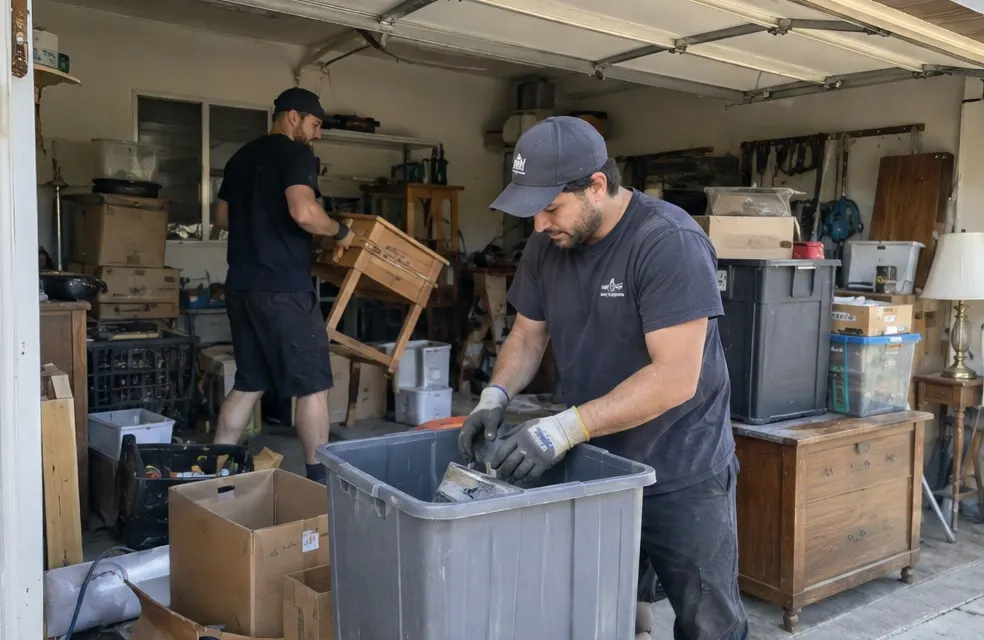
- Three piles on a tarp: donate, scrap, dump. Tarp a section of the driveway for each one
- Two people and the right equipment: dollies, a broom and a shop vac. Do not let one person carry an appliance down steps alone, and plan the carry before you start
- Heavy first, light last, and tied down: appliances and metal at the front, light bulky items on top, and a secured load. Florida's statute says that a vehicle may not be driven or moved on any highway unless the vehicle is so constructed or loaded that the load does not drop, shift, leak, blow or escape. Other states have their own rule
- Check before you toss: boxes in garages hide photos, papers and cash. Hand anything personal to the customer
How does sorting save money?
Each thing that skips the scale saves its weight and any item fee. Do the sum for one example: a working refrigerator donated and not dumped saves its 250 pounds (the EPA's table lists a refrigerator at 250), which at $91 a ton is $11.38, plus a refrigerant fee such as Napa's $29, so $40.38. That is real money, not a fortune. A donated dresser or a scrapped metal shelf saves less. The reason to sort is also the customer and the reviews: tell them "your tools went to someone who can use them". If a donation center or a scrap yard will take it, they decide what it takes, so call first.
Where do the jobs come from?
Realtors need garages cleared before listing photos. Estate sale companies leave behind what did not sell. Property managers clear units after a move-out. Look at your own job log to see which months bring garage jobs for you and post a garage page and a Google update then. A garage clean out page with your prices and photos is also what matches "garage clean out near me": see the website checklist.
How do you get paid?
On a $1,000 job, getting paid before you leave matters more than on a $175 one. The JunkPilot invoicing page describes sending the invoice by text or email from the truck with the final load size and extras, and the customer paying by card on their phone. It does not remove the need to confirm the price before you load.
Frequently asked questions
How much should I charge for a garage clean out?
Price it by the loads it fills, plus sorting time and any item the dump charges for. In the round example in this guide, a one-car garage that fills 1.7 truck loads is quoted at $925 for the haul plus $75 for an hour of sorting. Use your own load prices, crew cost and dump fees.
How long does a garage clean out take?
It depends on how much is in it and whether the customer wants to sort. The example in this guide assumes 6.25 crew hours for the haul plus one hour of sorting for a one-car garage that fills 1.7 loads. Time your first jobs and replace the assumption.