Pricing
How Much to Charge for Junk Removal (and Still Make Money)
How to price junk removal jobs from your real costs: minimums, load prices, add-ons for stairs and same day, and what to do about heavy debris.
 JunkPilot8 min read
In this article
Price junk removal by how much of the truck the job fills, and set each price from your own costs. In the round example below, a half load priced at $300 leaves $82 after the crew, the dump and overhead, while a quarter load priced at $175 leaves $17. So the first quarter needs to carry the drive and the dump minimum, and a minimum under about $110 loses money before overhead.
All numbers here are examples to show the sums. Change each one to yours. Dump fees come from the public pages named below, as we read them on 15 November 2026. This is not tax or legal advice: ask your state revenue department whether your services are taxable.
Step 1: what does one crew hour cost you?
Start with the hour, because every job is a number of hours plus a trip to the dump.
| Item | Example | Where the number comes from |
|---|---|---|
| Two people at $20 an hour | $40.00 | An assumption. The U.S. Bureau of Labor Statistics (BLS) reports that the median wage for hand laborers and material movers was $18.38 an hour in May 2025 |
| Employer payroll tax, 7.65% of $40 | $3.06 | The IRS lists 6.2% for Social Security and 1.45% for Medicare paid by the employer |
| Fuel and wear on the truck | $17.00 | An assumption: use your own fuel and repair records |
| One crew hour | $60.06, about $60 | Add the three lines |
Then work out overhead. Say your fixed costs are $3,000 a month (insurance, truck payments, marketing, phone, software, repairs) and you do 60 jobs. Each job carries $50. If a job takes 2 crew hours, 60 jobs is 120 crew hours, so overhead is $25 for every crew hour.
A crew hour that breaks even is therefore $60 plus $25, which is $85.
Step 2: what does the dump charge for this load?
Disposal is the cost new owners guess at. It is also local. Here are three public rate pages for the same 1,000 lb half load, which is 0.5 ton. The EPA's table lists mixed municipal solid waste, uncompacted, at 250 to 300 pounds per cubic yard, so a half load of 4 cubic yards is 1,000 to 1,200 pounds. This guide uses the low end.
| Facility | Rate on its page | Cost of 1,000 lb |
|---|---|---|
| Weber County transfer station, Utah | $35.50 per ton base rate plus fees, $27 minimum for non-customers | $17.75 by weight, so the $27 minimum applies |
| Devlin Road transfer station, Napa area, California | $48 minimum per vehicle up to 1,000 lb, $91 per ton over that | $48 |
| DeKalb County, Georgia | $105 per ton at its transfer stations | $52.50 |
The same pile costs from $27 to $52.50 to dump, and a full ton costs from $35.50 to $105. Each page adds taxes, surcharges or item fees on top. So you cannot copy another company's price: it was built on its dump. The rest of this guide uses $48, the highest minimum listed. Ask your own dump and replace it.
Step 3: build the load ladder from your costs
Customers want one number. Volume pricing gives it to them. The JunkPilot estimate calculator ships with example prices of $175 for the first quarter of the truck and $125 for each quarter after, set at a South Florida ballpark and not from a market survey. That makes a half load $300, three quarters $425 and a full load $550. Here is what those prices leave in the example. The crew hours are assumptions: time yourself on real jobs. The weights are the EPA's 250 pounds per cubic yard times the cubic yards of each load (2, 4, 6 and 8).
| Load | Price | Crew hours, at $60 | Dump cost | Overhead | Left over |
|---|---|---|---|---|---|
| Quarter | $175 | 1, so $60 | $48 (minimum) | $50 | $17 |
| Half | $300 | 2, so $120 | $48 (1,000 lb) | $50 | $82 |
| Three quarters | $425 | 2.75, so $165 | $68.25 (1,500 lb is 0.75 ton at $91) | $50 | $141.75 |
| Full | $550 | 3.5, so $210 | $91 (2,000 lb is 1 ton at $91) | $50 | $199 |
The pattern is real in any market: the first quarter carries the drive, the setup and the dump minimum, and each extra quarter is mostly loading. So if the quarter load is thin, raise the first quarter, not every quarter. A quarter at $200 in this example leaves $42.
Our guide on junk removal pricing per load shows how to size a pile on the phone, and the free junk removal cost calculator lets a customer try it.
Step 4: where should your minimum be?
A minimum job is one item and about one crew hour. The cost before overhead is one crew hour ($60) plus the dump minimum. That is $87 with Weber County's $27 minimum and $108 with Napa's $48. So a $75 minimum loses money in this example before it pays any overhead. Work yours out as: crew hour, plus your dump minimum, plus a share of overhead, plus the profit you want.
Step 5: add-ons that cover a real cost
Decide now what each add-on costs you. These are the JunkPilot calculator's example add-on prices next to what the dump pages above charge. Change the calculator to yours.
| Add-on | Calculator example | What the dump pages list |
|---|---|---|
| Mattress or box spring | $45 | Weber County: $15 each, plus the base fee. Napa: two mattresses with no charge, otherwise included in the weight fee |
| Refrigerator or air conditioner | $45 | Weber County: $10 to remove Freon. Napa: $29 per unit. DeKalb: $50.40 for each appliance containing Freon |
| Tires, each | $15 | Weber County: $4. DeKalb: $3.50 for tires under 18 inches, $16 over. Napa: $20 for 16 inches or less |
| Same-day pickup | $75 | Not a dump fee: you move your day around |
| Stairs or long carry | $50 | Not a dump fee: it is crew time |
Read the middle column against the right one. In the DeKalb example, the $50.40 appliance fee is more than the $45 example price, so the refrigerator add-on loses money before any labor. In Napa, a $45 add-on leaves $16 over the $29 fee. That is why a calculator needs your numbers and not a national average.
The EPA says that the final disposer of appliances is responsible for recovering any refrigerant contained in appliances, which is why dumps charge for it or refuse a unit. Ask yours what proof it wants before you load a refrigerator.
Step 6: heavy debris is priced by weight, not by the quarter
A truck full of old couches is light. The same space filled with concrete, dirt or roofing can pass the trailer's rating, and dumps charge by weight. The Napa page lists a different rate for each: $34 per ton for clean concrete or asphalt and $91 per ton for mixed construction debris.
Here is the sum. A load that weighs 3,000 lb is 1.5 tons. At $91 a ton the dump costs $136.50. If it is clean concrete at $34 a ton, it costs $51. A flat quarter-load price would hide that difference, so give heavy material its own price per cubic yard and never fill the truck more than about half with it. The JunkPilot calculator example for heavy debris is $150 for the first cubic yard and $110 for each one after, so 3 cubic yards is $370. Weigh your first ten heavy loads and write down the ticket weights before you trust any price.
Step 7: when to charge by the hour
Most jobs are better as a load price, because the customer wants a number before you start. Hourly works for jobs where volume is hard to see: sorting an estate with the family, light demolition, or a hoarding cleanout.
Use the sum from Step 1. A crew hour that breaks even is $85. If you want 25 percent of the price as profit, divide by 0.75: $85 divided by 0.75 is about $113 per crew hour. Quote it as a range with a cap, and say it plainly. Here is a text you can send, in the owner's voice:
"For sorting through the house I charge $113 an hour for a two person crew, with a two hour minimum. I will check in with you at the two hour mark so there are no surprises."
Step 8: a worked job, start to finish
A customer has a sectional, a mattress and ten boxes. That is about a half load, 1,000 lb. Your price: $300. If your dump charges for the mattress, add that fee as a line (Weber County lists $15 each).
- Crew: 2 hours at $60 is $120
- Dump: $48
- Overhead: $50
- Left: $300 minus $120 minus $48 minus $50 is $82, which is 27 percent of the price
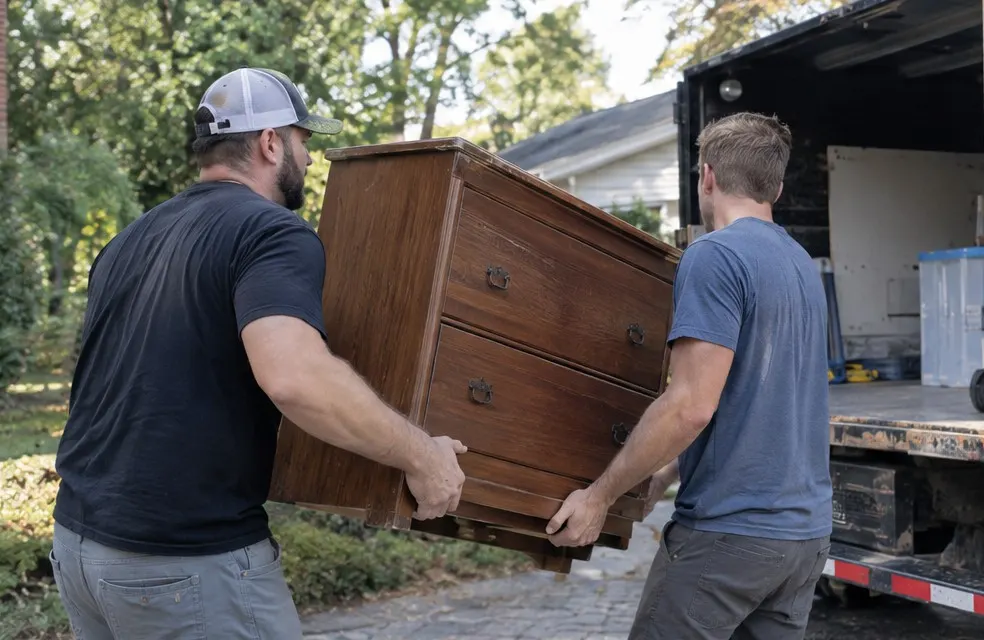
Give the dresser to a donation center and you skip its dump cost too.
Confirm on site, before loading
Show the customer where the load will reach on the empty bed, and agree on the price before the first item goes on. Here is a script:
"From what I can see that is a half truck, so $300. If it fills more than that I will tell you before I load, not at the dump."
Customers rarely argue with a price they agreed to with their own eyes. If the pile is bigger than the photo showed, say it at the door.
Show your prices
Every company is afraid to post prices, and every customer wants them. Showing load prices on your site, with a note that the final price is confirmed on site by how much of the truck the job fills, filters out the people who wanted it for $40, and makes the phone call short. See the pricing page for how JunkPilot plans are priced, and our junk removal website checklist. If you are still setting up, read how to start a junk removal business for the break-even sum that uses these same numbers.
Frequently asked questions
What is the average price for junk removal?
There is no single national price, because dump fees alone differ: from $35.50 to $105 a ton on the three public rate pages we read on 15 November 2026. Price from your own costs. In this guide's example, a quarter load is $175, a half load $300 and a full load $550, and the half load leaves $82 after crew, dump and overhead.
Should I charge by the hour or by the load?
By the load for almost every job. Customers want a number before you start. Hourly works for odd jobs like demolition or sorting an estate, where volume is hard to predict. In the example, a crew hour that breaks even is $85.
What is a good minimum charge for junk removal?
Enough to cover one crew hour and your dump minimum before overhead. With a $60 crew hour and dump minimums of $27 to $48, that is $87 to $108 in the example, so a $75 minimum would lose money. Use your own numbers.